In cryptography, a group key is a cryptographic key that is shared between a group of users. Typically, group keys are distributed by sending them to individual users, either physically, or encrypted individually for each user using either that user's pre-distributed private key. A common use of group keys is to allow a group of users to decrypt a broadcast message that is intended for that entire group of users, and no one else. For example, in the Second World War, group keys (known as "iodoforms", a term invented by a classically educated non-chemist, and nothing to do with the chemical of the same name) were sent to groups of agents by the Special Operations Executive. These group keys allowed all the agents in a particular group to receive a single coded message. In present-day applications, group keys are commonly used in conditional access systems, where the key is the common key used to decrypt the broadcast signal, and the group in question is the group of all paying subscribers. In this case, the group key is typically distributed to the subscribers' receivers using a combination of a physically distributed secure cryptoprocessor in the form of a smartcard and encrypted over-the-air messages.
SCADA Strangelove
SCADA Strangelove is an independent group of information security researchers founded in 2012, focused on security assessment of industrial control systems (ICS) and SCADA. == Activities == Main fields of research include: Discovery of 0-day vulnerabilities in cyber physical systems and coordinated vulnerability disclosure; Security assessment of ICS protocols and development suites; Identification of publicly Internet-connected ICS components and secure it with help of proper authorities; Development of security hardening guides for ICS software; Mapping cybersecurity on to functional safety; Awareness control and delivery of information regarding the actual security state of ICS systems. SCADA Strangelove's interests expand further than classic ICS components and covers various embedded systems, however, and encompass smart home components, solar panels, wind turbines, SmartGrid as well as other areas. == Projects == Group members have and continue to develop and publish numerous open source tools for scanning, fingerprinting, security evaluation and password bruteforcing for ICS devices. These devices work over industrial protocols such as modbus, Siemens S7, MMS, ISO EC 60870, ProfiNet. In 2014 Shodan used some of the published tools for building a map of ICS devices which is publicly available on the Internet. Open source security assessment frameworks, such as THC Hydra, Metasploit, and DigitalBond Redpoint have used Shodan-developed tools and techniques. The group has published security-hardening guidelines for industrial solutions based on Siemens SIMATIC WinCC and WinCC Flexible. The guidelines contain detailed security configuration walk-throughs, descriptions of internal security features and appropriate best practices. Among the group’s more noticeable projects is Choo Choo PWN (CCP) also named the Critical Infrastructure Attack (CIA). This is an interactive laboratory built upon ICS software and hardware used in real world. Every system is connected to a toy city infrastructure, which includes factories, railroads and other facilities. The laboratory has been demonstrated at various conferences including PHDays, Power of Community, and 30C3. Primarily the laboratory is used for the discovery of new vulnerabilities and for evaluation of security mechanisms, however it is also used for workshops and other educational activities. At Positive Hack Days IV, contestants found several 0-day vulnerabilities in Indusoft Web Studio 7.1 by Schneider Electric, and in specific ICS hardware RTU PET-7000 during the ICS vulnerability discovery challenge. The group supports Secure Open SmartGrid (SCADASOS) project to find and fix vulnerabilities in intellectual power grid components such as photovoltaic power station, wind turbine, power inverter. More than 80 000 industrial devices were discovered and isolated from the Internet in 2015. == Appearances == Group members are frequently seen presenting at conferences like CCC, SCADA Security Scientific Symposium, Positive Hack Days. Most notable talks are: === 29C3 === An overview of vulnerabilities discovered in the widely distributed Siemens SIMATIC WinCC software and tools that are implemented for searching ICS on the Internet. === PHDays === This talk consisted of an overview of vulnerabilities discovered in various systems produced by ABB, Emerson, Honeywell and Siemens and was presented at PHDays III and PHDays IV. === Confidence 2014 === Implications of security research aimed at realization of various industrial network protocols Profinet, Modbus, DNP3, IEC 61850-8-1 (MMS), IEC (International Electrotechnical Commission) 61870-5-101/104, FTE (Fault Tolerant Ethernet), Siemens S7. === PacSec 2014 === Presentations of security research showing the impact of radio and 3G/4G networks on the security of mobile devices as well as on industrial equipment. === 31C3 === Analysis of security architecture and implementation of the most wide spread platforms for wind and solar energy generation which produce many gigawatts of it. === 32C3 === Cybersecurity assessment of railway signaling systems such as Automatic Train Control (ATC), Computer-based interlocking (CBI) and European Train Control System (ETCS). === China Internet Security Conference 2016 === In "Greater China Cyber Threat Landscape" keynote by Sergey Gordeychik an overview of vulnerabilities, attacks and cyber-security incidents in Greater China region was presented. === Recon 2017 === In talk "Hopeless: Relay Protection for Substation Automation" by Kirill Nesterov and Alexander Tlyapov security analysis results of key Digital Substation component - Relay Protection Terminals was presented. Vulnerabilities, including remote code execution in Siemens SIPROTEC, General Electric Line Distance Relay, NARI and ABB protective relays was presented. == Philosophy == All names, catchwords and graphical elements refer to Stanley Kubrick’s film, Dr. Strangelove. In their talks, group members often refer to Cold War events such as the Caribbean Crisis, and draw parallels between nuclear arms race and the current escalation of cyberwar. Group members follow the approach of “responsible disclosure” and “ready to wait for years, while vendor is patching the vulnerability”. Public exploits for discovered vulnerabilities are not published. This is on account of the longevity of ICS and by implication the long process of patching ICS. However, conflicts still happen, notably in 2012 when the talk at DEF CON was called off due to a dispute of persistent weaknesses in Siemens industrial software.
IBM Retail Store Systems
This article describes IBM point of sale equipment from 1973 with the introduction of the IBM 3650 till 1986 with the introduction of the IBM 4680. IBM continued to announced new retail products until the sale of the IBM Retail Store Solutions business to Toshiba TEC, announced on 17 April 17 2012. == Background == IBM began selling retail point of sale systems starting in 1973 with the IBM 3650 Retail Store System aimed at department and chain stores and the IBM 3660 Supermarket System designed for supermarkets. The IBM 3650 was announced alongside other IBM vertical industry systems such as the IBM 3600 Finance Communication System, and the IBM 3790 communications system, the combination of which IBM described as a "revolution in terminal based systems". All of these systems relied on a significant number of developments across IBM: New chips: Large Scale Integration allowed advanced Field Effect Transistor logic chips that packed far more transistors onto a new metalized one-inch square ceramic substrate Gas panels: Developed as an alternative to cathode ray tubes, the neon argon gas panel provided clear and flicker-free images. Modem communications: Synchronous Data Link Control provided lower-cost communications over telephone lines New disks: The "Gulliver" disk file that supplied a hard drive smaller than three cubic feet and also the "Igar" diskette drive Smaller printers: A disk printer system called "spica" that used a rotating disk print element with engraved print elements that are struck by a single hammer as the disk rotates Belt printers: A new system, known as "Lynx," using a removable belt that was significantly cheaper, quieter and simpler than earlier chain printers Keyboards: New keyboard technology called "Calico" that could build a wide variety of keyboards using common manufacturing facilities Power supplies: Transistorised Switching Regulators or TsRs: compact power supplies that are one third to one-fourth the size of previous generations === Store Loop (SLOOP) architecture === The 36xx retail terminals are connected to the store controller via a loop also called a Store Loop, similar to that used by the IBM 3600 Finance System. If a terminal detects an error, it runs a self-diagnosis routine, displays an error code to the operator, and uses bypass circuitry to remove itself from the loop and allow the loop to continue operating. If the loop fails, the most downstream terminal transmits an error code to the controller. Intermittent errors are written to disk on the store controller. === Supplies Manufacturing === While IBM's Data Processing Division created the retail store systems, it's Information Record Division (IRD) also saw signifiant opportunity in manufacturing supplies for retail systems. As an example in their Dayton NJ plant they used a high-speed Webtron press to create up to 1 million magnet merchandise tags per shift. == IBM 3650 Retail Store System == The 3650 System is a family of products designed to computerise a retail store, both at the point of sale and for back office store management functions. It includes a method to generate encoded tickets for merchandise, rather than use the Universal Product Code (UPC). The key devices for the system were as follows: === Shop Floor === ==== 3653 Point of Sale Terminal ==== Designed for the store floor, it is a loop attached device with: a wire matrix printer with 3 stations: cash receipt, sales-check and transaction journal. a keyboard with 10 numeric keys and 19 function keys an 8 digit display and description lights. in addition to the 8 digits it also displays the following characters: "$", "." and "-" operator guidance panel with 20 backlit captions status indicators a cash drawer a check verification station. Options include a wand magnet label reader with a 4 foot flexible cord, and locks for the journal tape and the till cover. The terminal effectively loads its software remotely from the 3651 over the loop, which IBM calls an IML (initial microcode load). It can also be IMLed locally using a tape cassette recorder. IBM later offered a choice of OEM Wand Attachments that could be ordered by RPQ that could use OCR or scan UPCs, instead of a wand magnet label reader. Only one wand could be attached to a specific 3653. There are two models: Model 1, which is not programmable. Was announced 10 August 1973. Model P1, which is customer programmable. Has 36 KB of storage expandable to 60 KB. Was announced 13 October 1978. === Back office equipment === ==== 3651 Store Controller ==== Controls data flow inside either a single store or multiple stores and sends retail transactions to a mainframe using a modem. For point of sale it performed functions such as: Automatic price lookup from a master price file Automatic distribution of net sales by up to 54 departments Automatic application of applicable discounts and sales taxes Automatic control of food stamp maximums Check authorization facilities For back office it also helped report preparation such as: store summary individual cashier performance store office reconciliation sales by up to 54 departments Current inquiries for department sales; cashier performance & cash position; store cash position. Inquiries and changes to the master price records and operator authorization control records. Setting the time and date for the internal clock. Running the customer checkouts in training mode. Printing of messages received from the host mainframe Entry of messages to send to the host mainframe Reporting of customer stock returns Updating the system with data received from the mainframe Preparing shelf Labels Basic features include: Each loop attaches up to 63 or 64 terminals depending on traffic volumes and desired response times Has an error and operator panel. There were many models including: A25 Has a 5 MB internal disk. Has 60K of memory expandable to 76KB. Supports one store loop. Attaches to 3275, 3653 and 3663. Announced 19 May 1978, withdrawn 19 February 1981 B25 Same as a A25 with a 9.2 MB internal disk. Announced 19 May 1978 C25 Announced 15 May 1981, withdrawn 15 December 1987 A50 Has a 5 MB internal disk. Announced 5 May 1975. Announced 10 August 1973, withdrawn 15 December 1987 B50 Same as B50 with a 9.2 MB internal disk. Announced 5 May 1975, withdrawn 15 December 1987 A60 Has a 5 MB internal disk. Has an integrated 3669. Attaches up to 24 3663 terminals. Announced 11 October 1973, withdrawn 15 December 1987 B60 Same as A60 with a 9.3 MB internal disk. Announced 17 November 1975, withdrawn 15 December 1987 A75 Has 5 MB internal disk. Has 60K of memory expandable to 124KB. Supports one to three store loops. Attaches to 3275, 3653, 3657, 3784 and 3663 terminals. Announced 19 May 1978 B75 Same as A75 with 9.3 MB internal disk. Announced 19 May 1978, withdrawn 15 December 1987 C75 Same as A75 with 18.6 MB internal disk. Announced 19 May 1978, withdrawn 15 December 1987 D75 Same as A75 with 27.9 MB internal disk. Announced 19 May 1978, withdrawn 15 December 1987 There were also two additional models that could be used instead of the 3651: 7480 Model 1: Has a 18.6 MB internal disk 7480 Model 2: Has a 27.9 MB internal disk ==== 3872 Modem ==== Used to attach to a 3659 for remote loops. Each 3872 can attach three 3659s. ==== 3659 Remote Communication Unit ==== Connected to an IBM 3872 and provides a remote loop for up to 64 point of sale terminals. Announced 10 August 1973, withdrawn 15 December 1987 (Model 2, announced 17 March 1976, withdrawn 20 December 1982) Intended to be used in a back office location like the store manager's office or the data entry office ==== 3275-3 Display Station ==== It is a loop attached display terminal with printer attachment hardware ==== 3784 Line Printer ==== A belt printer for higher-volume end-of-day reporting. The maximum print speed is 155 Ipm using a 48 character set. ==== 3657 Ticket Unit ==== Used to print tickets and encoded labels to attach to store merchandise. It is a loop attached device. It prints the following: 1" by 1" adhesive backed labels with up to 11 characters at 500 tickets per minute. IBM sold these in rolls of 9000 1" x 2" tickets with up to 42 encoded characters and two lines of print of up to 21 characters at 250 tickets per minute. IBM sold these in rolls of 2800 1" x 3" tickets with up to 79 encoded characters and two lines of print of up to 32 characters at 167 tickets per minute. IBM sold these in rolls of 1900 It can also batch read the tickets for validation, separating good tickets from bad ones into two cartridges. Announced 10 August 1973, withdrawn 15 December 1987 ==== 7481 Data Storage Unit ==== This optional unit is used to record transaction data and initialize terminals if the store controller is not available. It uses a built in tape drive to store this data. === Early deployments === The first customer installation of a 3650 was at a Dillard's department store in Little Rock, Arkansas, in late 1974. They placed arou
Bioelectronics
Bioelectronics is a field of research in the convergence of biology and electronics. == Definitions == At the first C.E.C. Workshop, in Brussels in November 1991, bioelectronics was defined as 'the use of biological materials and biological architectures for information processing systems and new devices'. Bioelectronics, specifically bio-molecular electronics, were described as 'the research and development of bio-inspired (i.e. self-assembly) inorganic and organic materials and of bio-inspired (i.e. massive parallelism) hardware architectures for the implementation of new information processing systems, sensors and actuators, and for molecular manufacturing down to the atomic scale'. The National Institute of Standards and Technology (NIST), an agency of the United States Department of Commerce, defined bioelectronics in a 2009 report as "the discipline resulting from the convergence of biology and electronics". Sources for information about the field include the Institute of Electrical and Electronics Engineers (IEEE) with its Elsevier journal Biosensors and Bioelectronics published since 1990. The journal describes the scope of bioelectronics as seeking to : "... exploit biology in conjunction with electronics in a wider context encompassing, for example, biological fuel cells, bionics and biomaterials for information processing, information storage, electronic components and actuators. A key aspect is the interface between biological materials and micro and nano-electronics." == History == The first known study of bioelectronics took place in the 18th century when Italian physician-scientist Luigi Galvani applied a voltage to a pair of detached frog legs. The legs moved, sparking the genesis of bioelectronics. Electronics technology has been applied to biology and medicine since the pacemaker was invented and with the medical imaging industry. In 2009, a survey of publications using the term in title or abstract suggested that the center of activity was in Europe (43 percent), followed by Asia (23 percent) and the United States (20 percent). == Materials == Organic bioelectronics is the application of organic electronic material to the field of bioelectronics. Organic materials (i.e. containing carbon) show great promise when it comes to interfacing with biological systems. Current applications focus around neuroscience and infection. Conducting polymer coatings, an organic electronic material, shows massive improvement in the technology of materials. It was the most sophisticated form of electrical stimulation. It improved the impedance of electrodes in electrical stimulation, resulting in better recordings and reducing "harmful electrochemical side reactions." Organic Electrochemical Transistors (OECT) were invented in 1984 by Mark Wrighton and colleagues, which had the ability to transport ions. This improved signal-to-noise ratio and gives for low measured impedance. The Organic Electronic Ion Pump (OEIP), a device that could be used to target specific body parts and organs to adhere medicine, was created by Magnuss Berggren. As one of the few materials well established in CMOS technology, titanium nitride (TiN) turned out as exceptionally stable and well suited for electrode applications in medical implants. == Significant applications == Bioelectronics is used to help improve the lives of people with disabilities and diseases. For example, the glucose monitor is a portable device that allows diabetic patients to control and measure their blood sugar levels. Electrical stimulation used to treat patients with epilepsy, chronic pain, Parkinson's, deafness, Essential Tremor and blindness. Magnuss Berggren and colleagues created a variation of his OEIP, the first bioelectronic implant device that was used in a living, free animal for therapeutic reasons. It transmitted electric currents into GABA, an acid. A lack of GABA in the body is a factor in chronic pain. GABA would then be dispersed properly to the damaged nerves, acting as a painkiller. Vagus Nerve Stimulation (VNS) is used to activate the Cholinergic Anti-inflammatory Pathway (CAP) in the vagus nerve, ending in reduced inflammation in patients with diseases like arthritis. Since patients with depression and epilepsy are more vulnerable to having a closed CAP, VNS can aid them as well. At the same time, not all the systems that have electronics used to help improving the lives of people are necessarily bioelectronic devices, but only those which involve an intimate and directly interface of electronics and biological systems. Bioelectronics could be used to develop new label-free methods for monitoring cancer cell invasion and drug resistance. For example, the electrical resistance of cancer cells could be used to predict the effectiveness of cancer drugs and to identify drugs that are most likely to be effective against a particular type of cancer. === Human tissue regeneration === Human tissue, like most tissue in multicellular life, is known to be capable of regeneration. While tissue such as skin and even large organs such as the liver have been shown significant capacity for regeneration much of the adult body is thought to possess limited natural regenerative ability. Research in the field of regenerative medicine has identified that developmental bioelectricity can be used to stimulate and modify tissue growth beyond what naturally occurs with efforts to demonstrate its feasibility in mammals underway. Some researchers believe that future advancements could allow for the regeneration of organs or even entire limbs using bioelectronic devices providing the correct signals. == Future == The improvement of standards and tools to monitor the state of cells at subcellular resolutions is lacking funding and employment. This is a problem because advances in other fields of science are beginning to analyze large cell populations, increasing the need for a device that can monitor cells at such a level of sight. Cells cannot be used in many ways other than their main purpose, like detecting harmful substances. Merging this science with forms of nanotechnology could result in incredibly accurate detection methods. The preserving of human lives like protecting against bioterrorism is the biggest area of work being done in bioelectronics. Governments are starting to demand devices and materials that detect chemical and biological threats. The more the size of the devices decrease, there will be an increase in performance and capabilities.
Digital classics
Digital classics is the application of the tools of digital humanities to the field of classics, or more broadly to the study of the ancient world. == History == Classics was one of the first of the humanities disciplines to adopt computing approaches; the first references to the use of computing in the classical humanities date to the early 1960s, which might be surprising considering the reputation of the discipline as old-fashioned and stuffily traditionalist. Major projects such as the Thesaurus Linguae Graecae, founded in 1972, and the text collections of the Packard Humanities Institute set the trend, and there are still a significantly large number of ancient world projects among Humanities Computing projects today. Also, the success of traditional scholarly publications in digital guises, such as seen in the Bryn Mawr Classical Review, and the early adoption of hypertext in high profile projects like the Perseus Digital Library helped to legitimize computing in the study of classics in ways that has not always been the case in other areas of the humanities. This apparent paradox may be as a result of the many methodologies and different sources of evidence that classicists have always had to embrace, from literary sources and linguistics, to art history and archaeology, history, philosophy, religious theory, ancient documents such as inscriptions and papyri, and so forth. The fragmentary nature of many of the texts and languages of the ancient world, the scattered evidence from the material culture of ancient Greece and Rome, and the necessity to evaluate all these varieties of evidence in context are particularly likely to benefit from digital approaches such as databases, text markup, image manipulation and machine learning. == Digital classics projects == There are currently several major projects that aim to encourage and develop digital approaches to classical scholarship. The Stoa Consortium at the University of Kentucky distributes news of the discipline, and serves as a peer-reviewed electronic publication venue, and encourages open source approaches to digital classics. The Perseus Project is a digital library that also provides a collection of digital texts and analysis tools to the public; principally (but not exclusively) classical. Digital Classicist is another project and community which shares information and advice about the digital humanities applied to the field of classics. Epigraphy.info is an international open community pursuing a collaborative environment for digital epigraphy. The Liverpool Classics Mailing List is a project which can be subscribed to in which one receives email regarding Classics events around the world, as well as call for papers, studentships and public lectures.
Intelligent automation
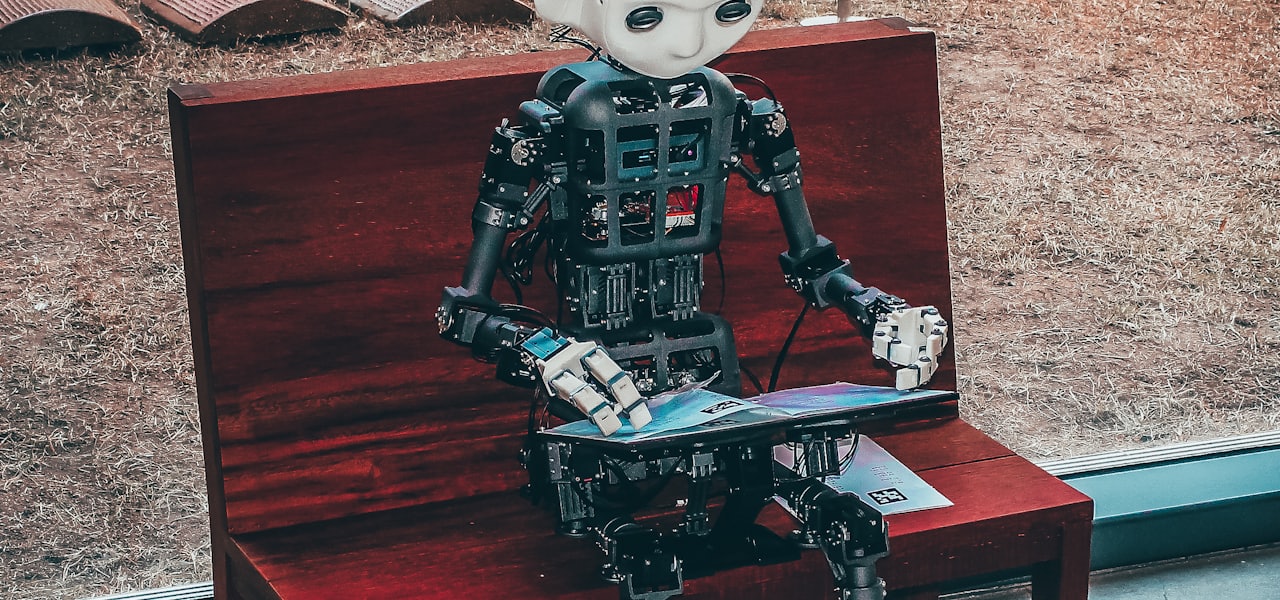
Intelligent automation (IA), or intelligent process automation, is a software term that refers to a combination of artificial intelligence (AI) and robotic process automation (RPA). Companies use intelligent automation to cut costs and streamline tasks by using artificial-intelligence-powered robotic software to mitigate repetitive tasks. As it accumulates data, the system learns in an effort to improve its efficiency. Intelligent automation applications consist of, but are not limited to, pattern analysis, data assembly, and classification. The term is similar to hyperautomation, a concept identified by research group Gartner as being one of the top technology trends of 2020. == Technology == Intelligent automation applies the assembly line concept of breaking tasks into repetitive steps to improve business processes. Rather than having humans perform each step, intelligent automation can replace steps with an intelligent software robot, improving efficiency. Intelligent automation integrates robotic process automation (RPA) with artificial intelligence techniques (such as machine learning, natural-language processing, and computer vision) enabling systems to interpret data, make decisions, and adapt to changing inputs. Modern platforms use a layered architecture combining workflow orchestration, low-code tools, integration middleware, and AI services to coordinate bots and data pipelines across organisational systems. == Applications == Intelligent automation is used to process unstructured content. Common real-world applications include self-driving cars, self-checkouts at grocery stores, smart home assistants, and appliances. Businesses can apply data and machine learning to build predictive analytics that react to consumer behavior changes, or to implement RPA to improve manufacturing floor operations. For example, the technology has also been used to automate the workflow behind distributing COVID-19 vaccines. Data provided by hospital systems’ electronic health records can be processed to identify and educate patients, and schedule vaccinations. Intelligent automation can provide real-time insights on profitability and efficiency. However, in an April 2022 survey by Alchemmy, despite three quarters of businesses acknowledging the importance of Artificial Intelligence to their future development, just a quarter of business leaders (25%) considered Intelligent Automation a “game changer” in understanding current performance. 42% of CTOs see “shortage of talent” as the main obstacle to implementing Intelligent Automation in their business, while 36% of CEOs see ‘upskilling and professional development of existing workforce’ as the most significant adoption barrier. IA is becoming increasingly accessible for firms of all sizes. With this in mind, it is expected to continue to grow rapidly in all industries. This technology has the potential to change the workforce. As it advances, it will be able to perform increasingly complex and difficult tasks. In addition, this may expose certain workforce issues as well as change how tasks are allocated. Tools such as Semrush's AI Visibility Toolkit and Enterprise AIO reflect these developments by analysing how entities are referenced and represented within responses produced by large-language-model-based systems. == Benefits == Streamline processes: Repetitive manual tasks can put a strain on the workforce. However, with AI agents, these tasks can be automated to allow teams to focus on more important matters that require human cognition. Intelligent automation can also be used to mitigate tasks with human error which in turn increases proficiency. This allows the opportunity for firms to scale production without the traditional negative consequences such as reduced quality or increased risk. Customer service improvement: Customer service can be significantly improved, providing the firm with a competitive advantage. IA utilizing chat features allows for instant curated responses to customers. In addition, it can give updates to customers, make appointments, manage calls, and personalize campaigns. Flexibility: Due to the wide range of applications, IA is useful across a variety of fields, technologies, projects and industries. In addition, IA can be integrated with current automated systems in place. This allows for optimized systems unique to each firm to best fit their individual needs. == Capabilities == Cognitive automation: Employs AI techniques to assist humans in decision-making and task completion Natural language processing: Allows computers to automate knowledge work Business process management: Enhances the consistency and agility of corporate operations Process mining: Applies data mining methods to discover, analyze, and improve business processes Intelligent document processing: Utilizes OCR and other advanced technologies to extract data from documents and convert it into structured, usable data Computer vision: Allows computers to extract information from digital images, videos, and other visual inputs Integration automation: Establishes a unified platform with automated workflows that integrate data, applications, and devices.
Are We Dating The Same Guy?
Are We Dating The Same Guy?, also abbreviated AWDTSG is a series of over 200 individual Facebook groups where women share dating profiles of men they matched with on dating networks to seek the opinion of other women who may have dated the same man in the past. The first group was created by Paola Sanchez and aimed at women living in the New York City environs. The groups have over 3.5 million members as of January 2024. The group's function is to post screenshots of a man's dating profile to that city's designated Facebook group, after which the poster asks "any tea?". Other users in the group will then share information about the man and share warnings. The groups are moderated by volunteers, and have been described as a feminist group. The groups have rules saying that personal information such as addresses must not be included in the Facebook posts. Users attempting to join the group are also examined to prevent fake profiles. The group is mainly for straight women. According to Vice, the men being posted about have no way to defend against accusations made about them, and on the other hand, posters cannot prove their stories unless backed up by others. Often times, members post pictures alongside personal information such as names, which may infringe on subjects' legal right to privacy. Lawyers have said these issues can lead to defamation lawsuits, and members can make false allegations and create fabricated stories. If members tell a man that he's been talked about on the group, the "snitch" will be banned and be "exposed to the whole group". == History == The first Are We Dating The Same Guy group was created by Paola Sanchez. The first group was created in March 2022 in New York City. A male counterpart, named "Are We Dating the Same Girl NYC" was created for New York, with mostly the same guidelines and rules to the original. When the original Are We Dating The Same Guy group found it, they denounced the new group. == Operations == Administrators are told not to respond to men asking to have posts about them removed, and to not remove said posts. The people being posted about have reported being questioned by their employers about things they have not done. Members of the groups sometimes criticise the physical appearance of the men being posted about. According to the Evening Standard, the groups "frequent[ly] mock" the appearance or dating profiles of the men who are posted about, despite being against the rules. For this behaviour, women are sometimes kicked out, or the group is disciplined en masse by admins. The groups have rules against hate towards men, but the rules can be difficult to enforce in large groups, with some having over 100,000 members. Some men have also been able to join the groups without being noticed. == Reception == In October 2023, Sera Bozza of Body+Soul wrote that consistently using Are We Dating The Same Guy can "affect your real-world view". She wrote that "A few stories of cheating may persuade you to believe that all men are unfaithful". Some lawyers and commentators have expressed concern that the groups fail to acknowledge the legal right to privacy and users can create false allegations and fabricated stories, and cyberbully men without them being able to defend themselves. This may lead to civil lawsuits against the author for defamation, harassment, and other related privacy torts. Netsafe, an online safety organisation in New Zealand, advises users of a similar group to familiarise themselves with the Harmful Digital Communications Act to ensure that posts do not lead to "harmful consequences". The Independent reported that men who have been posted on the dating groups have felt violated, and that even if reviewed positively by potentially thousands of strangers, the men being discussed about may have their reputation slightly decreased due to the association with being on the groups. The Independent also reported that some men believe that the groups are created to spread lies or mock them. Mashable reported that the growth of AWDTSG in recent years has led to the rise of a small industry of online reputation and content removal services, as increasing numbers of men seek assistance. A co-founder of Maximatic Media, one such agency offering these removal services, stated that many of the men contacting the firm do so in a state of panic after learning that allegations about them have circulated among tens of thousands of participants without their knowledge. Mashable similarly reported that the growing visibility of AWDTSG and similar platforms has contributed to what commentators describe as a "public trial" dynamic, where subjective accounts about dating behavior are interpreted as factual assessments and can influence a person's reputation among large audiences within their locale. The Oklahoman reported that anonymous, unverified claims in these groups have led some men to experience social and dating repercussions, although legal analysts argue that the benefits of community-based safety networks still outweigh these concerns in modern, app based dating environments. UTV/ITV News reportedly spoke to a man who was posted who alleged he attempted suicide, was clinically dead for three minutes, and spent three weeks in a psychiatric hospital as a result of the posts made about him. Many other men have talked about malicious false claims made about them. Self-described men’s rights activists have taken a dislike to these groups and have gotten multiple North American groups shut down by running campaigns, threatening lawsuits, and mass Facebook reporting. They also have Reddit communities dedicated to getting rid of such groups. Women who have posted in the groups have felt that they have put their safety at risk, with some having been confronted by the men they posted about. The group has been noted for exposing men who use dating apps while already in a relationship, misrepresent their ages, or repeatedly stand up the women they meet through apps, among other bad dating behaviors. For example, some members of the group had matched on a dating site with a man who had, several years prior, killed a stranger while having a mental break. After this information came to light, members of the group were warned. The group has also been noted to be complimentary of some men. == Lawsuits == In 2023, a 41-year-old man sued the administrators of the London group for $35,000 under defamation, alleging that the group "called names, accused of sending lewd photos and of being a bad parent". In January 2024 a man sued Meta, the owner of Facebook, along with Patreon, GoFundMe, and the AWDTSG website, as well as almost 30 group members due to alleged defamation, emotional distress, and invasion of privacy. Claiming that the groups violate anti-doxxing laws and do not fact check, seeking $75,000 in damages. He claims that the group shared fake images of him sending women texts containing harassment, his name and photo. His attorneys claim that if the images were real, they would fall under free speech in the First Amendment. By February, groups had raised $80,000. The Washington Post said that this case caused AWDTSG to "explode into public view". The case was dismissed in 2025 by the United States District Court for the Northern District of Illinois. On May 15, 2026, the United States Court of Appeals for the Seventh Circuit declined to renew the case in D'Ambrosio v. Meta Platforms Inc., et al. The plaintiff and his attorneys, Marc Trent and Aaron Walner of Trent Law Firm, were sanctioned "for frivolously appealing the dismissal of the claims," "misrepresentations of law," in connection with falsified citations included in the plaintiff's brief, and " disputing at oral argument without any evidentiary basis that [the plaintiff] client sent the text message she attributed to him." == By country == === Australia === In Australia, there are groups for multiple cities including Sydney, Melbourne, Adelaide, Perth, Brisbane and Rockhampton with many having several thousand members. The Sydney group has 30,000 members. In March 2023, the Adelaide version of the group, which had 7,000 members, was shut down. In 2024, groups titled "Sis, Are We Dating The Same Guy" stopped accepting new posts after an admin was sued for defamation and had to pay over AU$20,000 in legal fees. The case was settled out of court. The administrator announcing these closures cited a 2021 defamation High Court case involving detainee Dylan Voller, which led to the High Court saying that owners of Facebook groups can be held liable for defamatory comments, even if they did not know the comments had been made. === Canada === In 2023, a group was started for Ottawa. The founder previously was in a relationship full of "cheating and lies", which prompted her to creating the Facebook community. In 2023, the group for Vancouver and British Columbia was shut down after concerns about men being unable to protect themselves against fa